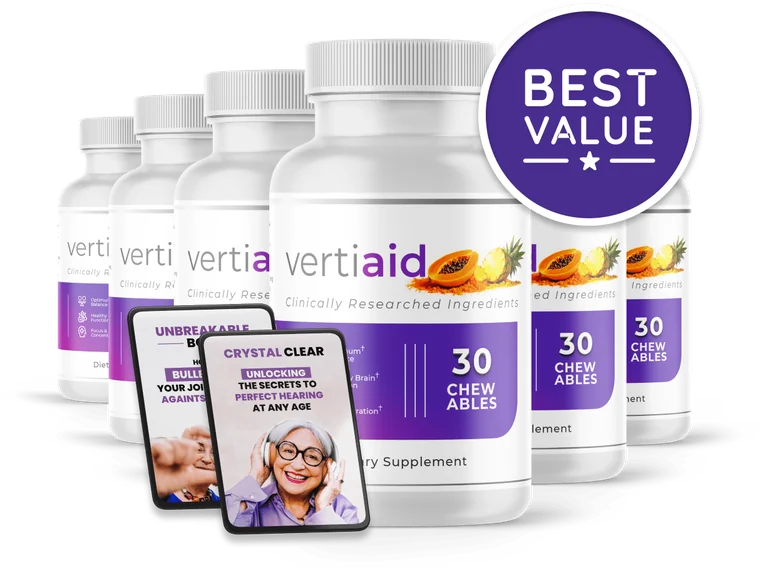
How Does VertiAid Work?
VertiAid's ingredients organize into four pathways: nutritional foundation, neuroprotection, connective tissue, and cognitive clarity.
Each pathway carries genuine, varying degrees of research support.
Four nutritional pathways
VertiAid's formula is organized around four complementary pathways relevant to vestibular health.
Pathway 1: vestibular nutritional foundation
Vitamin D3 deficiency is consistently correlated with BPPV in clinical research — Vitamin D plays a role in calcium metabolism within the inner ear's otoconia, the tiny crystals whose displacement causes BPPV episodes. Riboflavin B2 is studied for vestibular migraine prevention. See our piece on Vitamin D and BPPV: the real connection.
Pathway 2: neuroprotective mineral support
Zinc-L-Carnosine offers documented neuroprotective and anti-inflammatory properties, with some clinical observations linking zinc deficiency to vestibular dysfunction. Potassium supports the nerve signal transmission vestibular processing relies on.
Pathway 3: structural & connective tissue support
Marine Collagen and Eggshell Membrane Collagen provide structural proteins relevant to inner-ear connective tissue, while Aquamin® calcium offers a highly bioavailable mineral matrix.
Pathway 4: cognitive clarity support
American Ginseng has documented effects on cognitive function and mental clarity — relevant since vertigo often co-occurs with brain fog and difficulty concentrating.
What this means for you
These pathways carry genuine, varying degrees of research support. See the ingredient list and what it's built to support.